

After ICE Sweeps Somalis—Who’s Next?
Somalis in the Twin Cities are the latest focus of Donald Trump’s immigration enforcement machine. Afghan communities in the Mid-Atlantic could face similar scrutiny.

ICE Targets Somali Immigrants in Minnesota
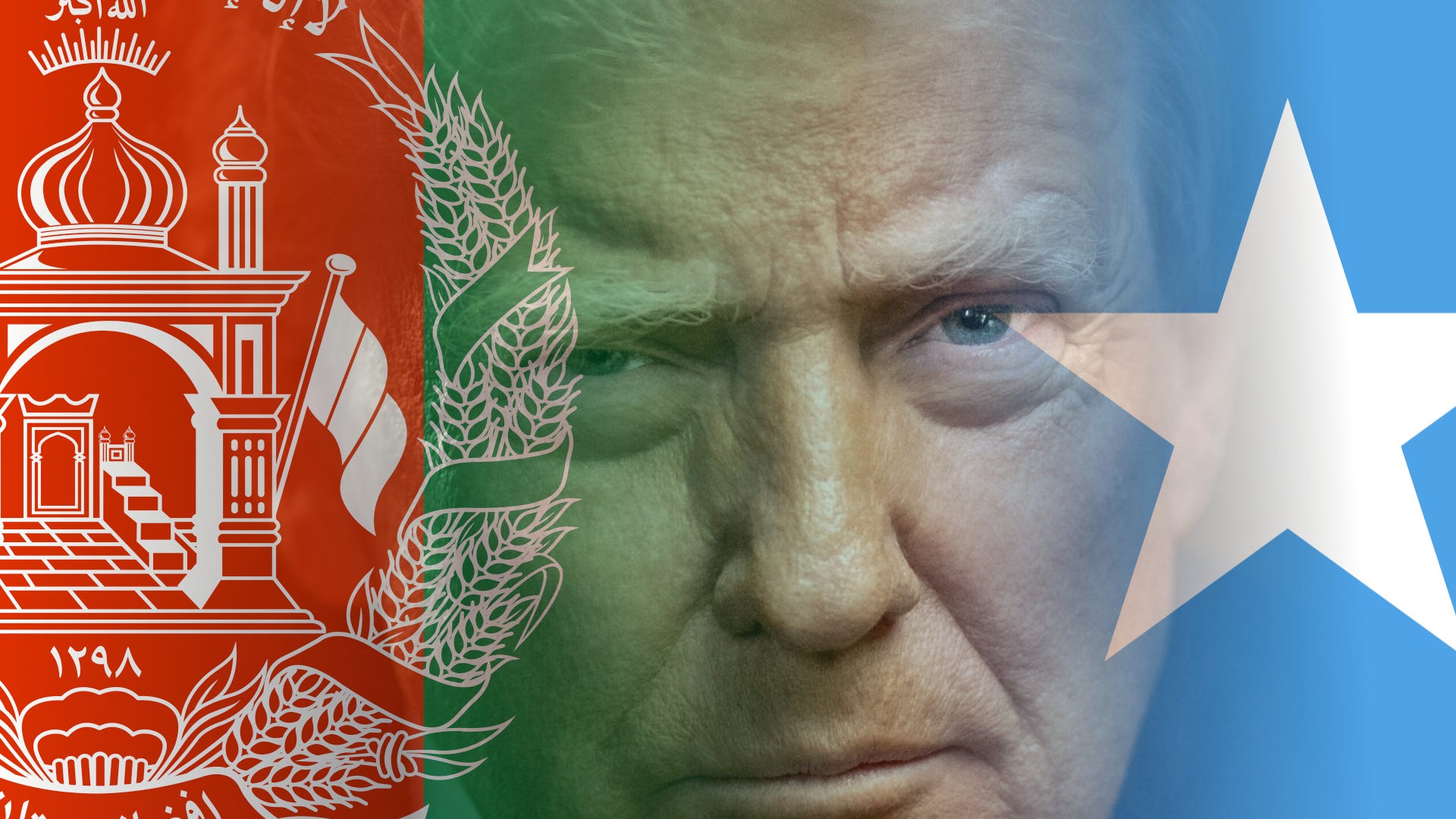
The Associated Press reported Tuesday that the Trump Administration may deploy Immigration and Customs Enforcement agents to Minneapolis and St. Paul to target undocumented Somali immigrants. The operation would come after months of federal spending to build enforcement capacity in the Twin Cities.
Customs and Border Protection contracted with Blue Construction Services LLC in September for temporary office space in Bloomington, Minnesota, running through March 2026. The same month, CBP purchased reconnaissance robots from Recon Robotics Inc. in Hopkins, Minnesota. The devices are throwable surveillance robots designed for building entry and room clearing. A separate million-dollar contract went to outfit new ICE agents with office designs and furnishings in Minneapolis.
The procurement activity preceded weeks of escalating rhetoric from Trump targeting Minnesota’s Somali community. On Thanksgiving, Trump posted on social media that Somalis were taking over Minnesota. He used a slur to describe Governor Tim Walz in the same post — an insult he has since stood by. Days later, Trump announced he would terminate Temporary Protected Status for Somali migrants in the state. On Tuesday, he called Somali immigrants and Representative Ilhan Omar “garbage” and said he does not want them in the country.
The crackdown follows a shooting near the White House last week that killed National Guardsman Spc Sarah Beckstrom and wounded West Virginia Air National Guardsman SSgt Andrew Wolfe. The alleged shooter, Rahmanullah Lakanwal, is an Afghan national—one of approximately 76,000 Afghans who arrived in the United States following the fall of Kabul in August of 2021. Trump used the shooting to justify reviewing green cards issued to migrants from nineteen countries on his travel ban list, including both Afghanistan and Somalia.
Mid-Atlantic Enforcement Build-up
The procurement documents in Minnesota reveal a pattern. Federal agencies build operational capacity before announcing enforcement operations. The Bloomington office space contract runs six months. The reconnaissance robots provide surveillance capability for building entries. The ICE office furnishings support expanded agent presence.
That same pattern exists throughout the Mid-Atlantic. Multiple solicitations and awards across Washington, D.C., Baltimore, and Northern Virginia indicate a steady buildup of infrastructure that mirrors the early-stage activity preceding the Minneapolis operation.
The General Services Administration recently issued a solicitation for fully finished and furnished law enforcement office space in Baltimore. The request seeks administrative space to support federal law enforcement operations and uses language nearly identical to the Bloomington lease that preceded the announcement of ICE’s Twin Cities deployment. The as-is requirement indicates a need for rapid occupation and immediate operational activation. To date, no contract has been awarded according to publicly available sources.
ICE also awarded a months-long contract to procure Meals Ready to Eat for detainees in the Baltimore Area of Responsibility. The duration and scope indicate planning for sustained detention needs rather than a short-term surge, mirroring the early logistical preparations that often precede field operations.
A broader solicitation for regional detainee transportation and guard services covers sixteen states and the District of Columbia, including Maryland, Pennsylvania, New Jersey, West Virginia, and other states in the New England region. The contract includes armed and unarmed transport, fixed security posts, and movement between facilities. This expansion of logistics could indicate preparations for larger enforcement operations involving transfers across multiple jurisdictions.

In Washington, D.C., ICE has posted a notice seeking GMC Yukon XL AT4 Ultimate SUVs suitable for surveillance, rapid response, and field operations. A separate solicitation through GSA seeks additional Yukon XL AT4 vehicles for ICE offices in Washington, Los Angeles, and Boston, signaling a coordinated rollout of identical fleet assets across multiple enforcement zones.
More concerning is a single-source purchase of twenty Roshel Senator armored tactical vehicles designed for high-risk enforcement and emergency response. The justification memo cites mission-readiness pressures and immediate availability—typically indicators of an anticipated operational surge or field environment requiring armored support.
Baltimore has also seen a significant infrastructure outlay: a $14 million purchase of office furniture to support Enforcement and Removal Operations. The award explicitly funds furnishings for ERO officers hired under the reconciliation bill, pointing to long-term staffing expansion and permanent workspace establishment rather than temporary or surge-based operations.
Altogether, these solicitations and contracts are concerning precedents to an operational expansion in our region. Trump has already cited the Washington shooting as justification to review green cards from nineteen countries. Afghanistan remains on the travel ban list. The administration has terminated Temporary Protected Status for multiple countries this year.
A Risk for Local Afghan Communities
This is not the first attack against Afghan communities in the United States. In August, the Trump administration took steps that undermined protections for Afghan immigrants in the US, including dismantling programs for Special Immigrant Visa holders, expanding deportations—including removing an Afghan immigrant, among 200 others, to Costa Rica—and limiting refugee resettlement opportunities.
According to a 2024 Migration Policy Institute report, Afghan immigrants in the United States number roughly 195,000, with the largest population concentrated in Northern California. The second-largest population lives in the Washington, D.C.–Baltimore metro area. Many are recent arrivals brought through humanitarian parole or Special Immigrant Visas as a part of Operation Allies Welcome following the end of the war in Afghanistan, making them particularly vulnerable to deportation, limited access to social services, and economic instability.
Trump has spent much of the summer publicly sparring with Maryland Governor Wes Moore and frequently criticizing Baltimore and its immigrant communities. The city will host Trump next week for the Army/Navy football game, and local immigration advocates and rapid response networks are bracing for a potential increase in ICE activity in the days leading up to the event. Baltimore is home to a growing Afghan population, bolstered in 2021 when numerous Afghan families were placed in the city.
Given the administration’s grievance-fueled politics and the ongoing build-up of enforcement infrastructure, the question I keep asking: are Afghan communities next?
Of course not justifying or defending any violence, but the tragedy in digging deeper into the alleged shooter, Rahmanullah Lakanwal, is that after being trained by/serving with the U.S./CIA-backed Afghan force unit, a former unit member reported that he faced financial pressure, ongoing apparent mental illness, and "felt abandoned by the U.S. government."
His unit mate said that he sought help from a CIA program designed to aid these "Zero Unit" veterans with immigration issues, but he was essentially ghosted by the CIA and received no assistance. His last post to the CIA went unanswered and was deleted by the chat’s administrator.
More details reported by Rolling Stone (non-paywall link here): https://archive.is/ac0bB#selection-1885.2-1889.256